API Authorization Attacks: BOLA & BFLA
Summary
Today I practiced two of the most critical API authorization vulnerabilities:
- Broken Object Level Authorization (BOLA)
- Broken Function Level Authorization (BFLA)
These issues are simple to exploit, easy to miss, and often lead to severe data exposure or account takeover in real-world APIs.
Why Authorization Bugs Are Dangerous
Authentication answers:
Who are you?
Authorization answers:
What are you allowed to do?
Many APIs rely only on tokens and forget to verify ownership and permissions on every request.
This creates silent but devastating vulnerabilities.
Broken Object Level Authorization (BOLA)
BOLA occurs when an API does not verify that the authenticated user owns the requested object.
Legitimate Request (User B)
1
2
GET /identity/api/v2/vehicle/943186f6-b753-4629-a9dc-cdb444fb90d/location
Authorization: Bearer USER_B_TOKEN
Attack Scenario (User A)
1
2
GET /identity/api/v2/vehicle/943186f6-b753-4629-a9dc-cdb444fb90d/location
Authorization: Bearer USER_A_TOKEN
Result
User A successfully accessed User B’s live GPS location.
Impact: Sensitive data exposure → privacy violation → potential physical risk.
Broken Function Level Authorization (BFLA)
BFLA happens when users can access actions outside their role.
Admin Endpoint Exposed
1
2
DELETE /identity/api/v2/admin/videos/758
Authorization: Bearer USER_B_TOKEN
Response
1
2
3
4
{
  "message": "User video deleted successfully",
  "status": 200
}
A normal user was able to execute an admin-only function.
Impact: Privilege escalation → destructive actions → full platform abuse.
Visualizing the Problem
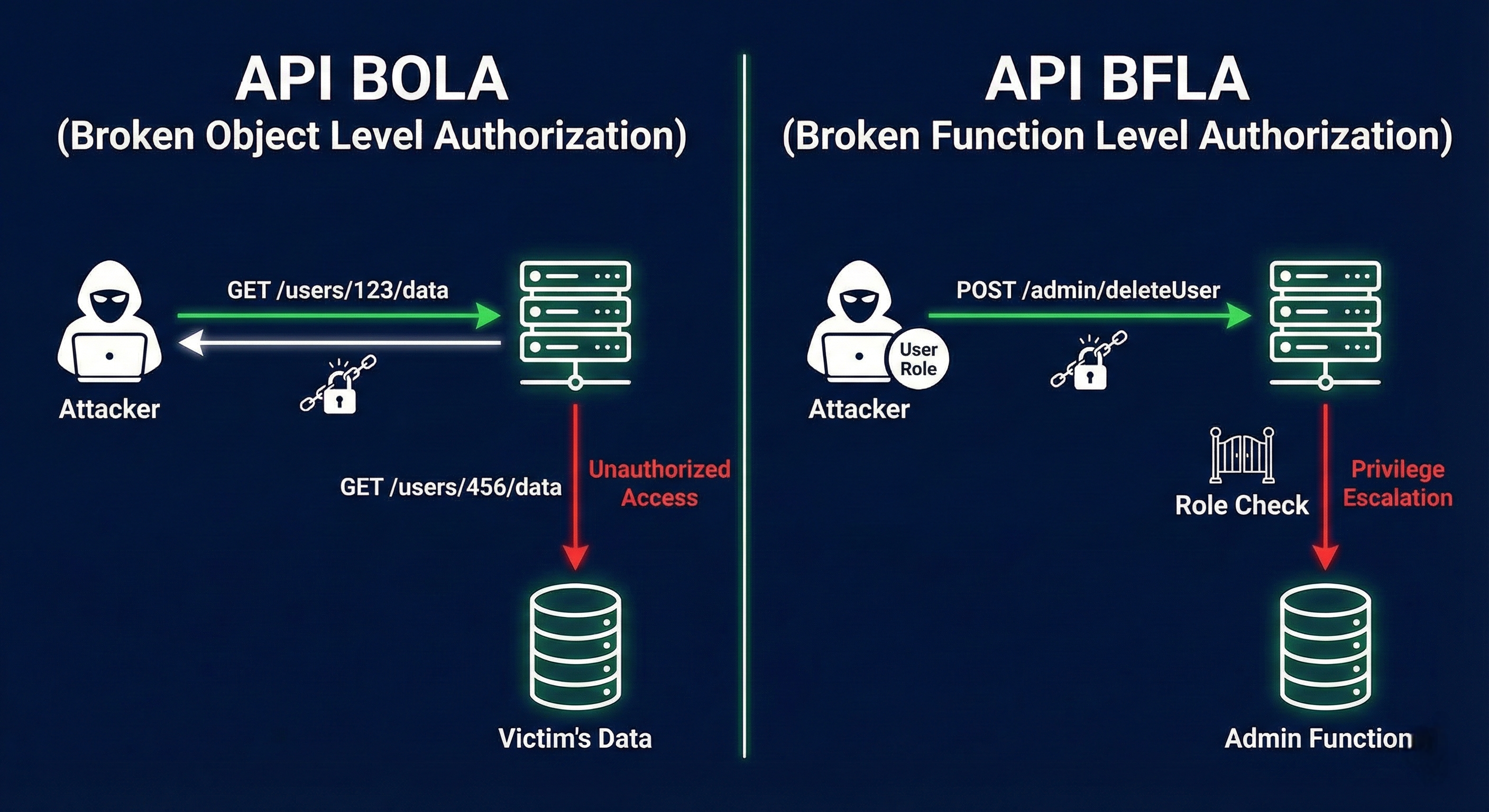
This diagram highlights the missing authorization checks:
- No ownership validation (BOLA)
- No role enforcement (BFLA)
Key Lessons
- Tokens do not equal authorization
Every request must validate:
- User identity
- User role
- Resource ownership
- IDs in URLs are attack surfaces
- Admin endpoints must never rely on client trust
Tools Used
- Postman
- Burp Suite (Proxy, Repeater)
Security Impact
Authorization bugs are among the highest impact API vulnerabilities.
They often lead to:
- Mass data leakage
- Account takeover
- Business logic abuse
- Regulatory violations
Key Takeaway
If an API checks who you are but not what you are allowed to access
👉 Authorization is already broken.