The Optional Checkpoint: Skipping a Mandatory Step in Multi-Step Flows
Okay so what even is a “state-machine bypass”?
Loads of apps have a flow that’s supposed to go in order. Think of any “someone does a job and proves it” workflow:
start the job → upload proof (a photo, a signature, a scan) → mark complete → money moves.
The app shows these as three screens, one after another. You literally can’t tap “Complete” until you’ve done the photo step — the button is greyed out.
That ordering is a state machine: the thing is allowed to move started → verified → completed, and not allowed to jump started → completed. The bug is simple to say and easy to miss: the server never actually enforces the order. Only the app does.
The setup (this is the important part)
Here’s the mental model of what’s usually running on the backend:
1
2
3
4
PATCH /job/start      -> state = "started"
PATCH /job/photos     -> state = "verified"   (the evidence step)
PATCH /job/complete   -> if state == "verified": pay out
                         // but what if it's only "started"?
The developer assumes complete is only ever called after photos, because that’s the only path the app offers. So they write complete to just… finalize. No check that the evidence step actually happened.
The app is a suggestion. The API is the real thing. If I can call complete straight after start, I skip the checkpoint entirely.
The attack
PATCH /job/start— totally legit, I’m allowed to start.- Skip
/job/photoscompletely. Never call it. PATCH /job/complete— and the server says200 OK, completed.
That’s it. The job is now “done”, the customer is billed, the payout fires — and there is no photo, no signature, no proof of anything attached to it. The one record that was supposed to make fraud detectable is simply absent, because the step that creates it was never required.
In a field-service / delivery / fuel / inspection context, that’s a corrupt operator’s dream: mark jobs complete, collect, and leave zero evidence of what was (or wasn’t) actually delivered. Disputes become un-investigatable because there’s nothing to investigate with.
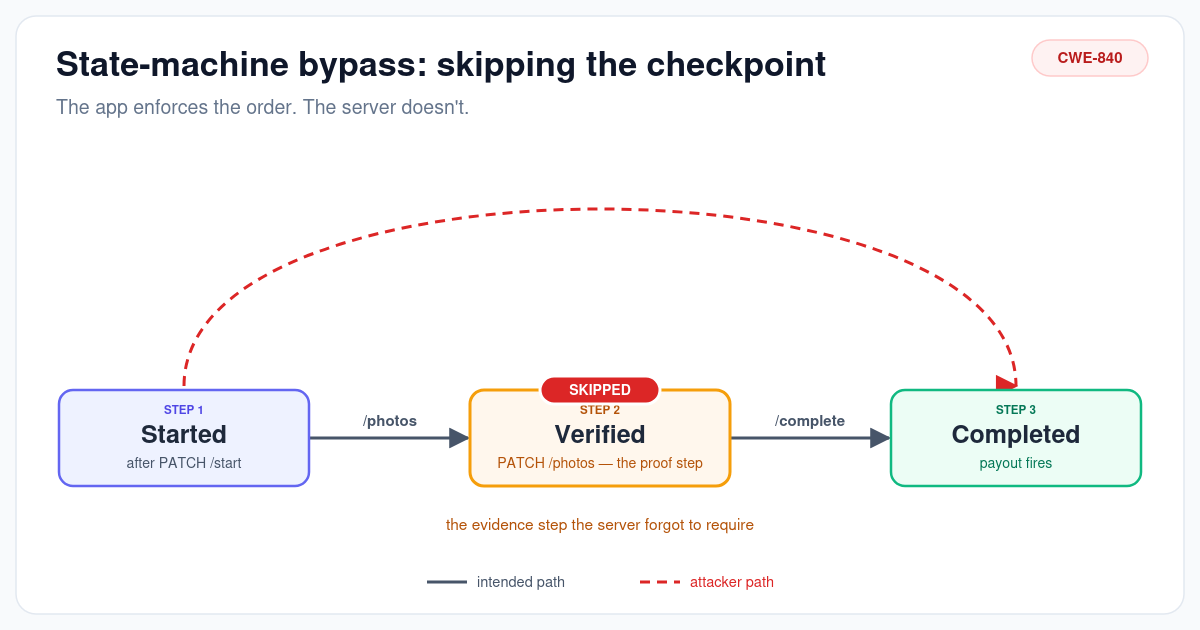 Intended flow: start → verify → complete. The server never checks the order, so calling
/complete straight after /start finalizes the job with the proof step skipped.
Why testers miss it (and how I nearly did)
Two traps, both about trusting the wrong thing:
- “The UI won’t let me, so the server won’t either.” You open the app, the Complete button is disabled until you add a photo, and your brain files it as “enforced.” It isn’t — the gate is client-side. Always re-fire the final call directly, out of order, from your own client.
- “I checked and the step is required.” Earlier in the same flow I convinced myself a value wasn’t even reachable, based on a truncated response dump that cut off one field too early. A negative claim (“this can’t be done”, “that field isn’t there”) needs the same proof as a positive one: print the full response of a fresh object, and test the exact out-of-order call. Don’t conclude from a half-read body.
The honest framing also matters for severity. In the flow I looked at, the money amount itself was cryptographically bound to an earlier token, so the operator couldn’t change the price — tampering it returned “data does not match.” So this isn’t “steal arbitrary money.” It’s an evidence / accountability bypass: the integrity control (proof-of-work) is optional. Name the bug for what it actually is (think CWE-840, business logic), and credit the controls that did hold. An over-claimed “Critical: fuel theft” gets you argued with; a precise “the verification step is not enforced server-side” gets fixed.
How I’d test for it
- Walk the flow once normally. Capture every request (Burp/ZAP history). Note the exact order and the state value in each response.
- Identify the “checkpoint” step — the one that produces proof/verification (photos, OTP, signature, approval).
- Start a fresh object, then jump straight to the final step, skipping the checkpoint. Does
completesucceed? - Try the other orderings too: complete twice, complete before start, cancel after complete. State machines leak in more than one place.
- Read the full response at each stage — don’t let a truncated log decide the verdict.
- Confirm the real-world effect: did the record finalize with the checkpoint data genuinely missing?
The fix (for devs reading this)
- Enforce transitions on the server, every time.
completemust reject unless the object actually passed through the required state (e.g.verified). A disabled button is UX, not a control. - Make the evidence step a hard precondition, not an assumed one — check that the proof exists before finalizing/paying.
- Treat the client as hostile: any step the UI enforces, assume an attacker will call the API without it.
TL;DR
If a multi-step flow has a “mandatory” checkpoint that’s only enforced by the app, try calling the final step straight after the first one. If the server finalizes with the checkpoint skipped, you’ve got a state-machine bypass. Score it by what’s actually lost — often it’s the evidence, not the money — and say so precisely.
Happy Hunting, Falcon0x1